


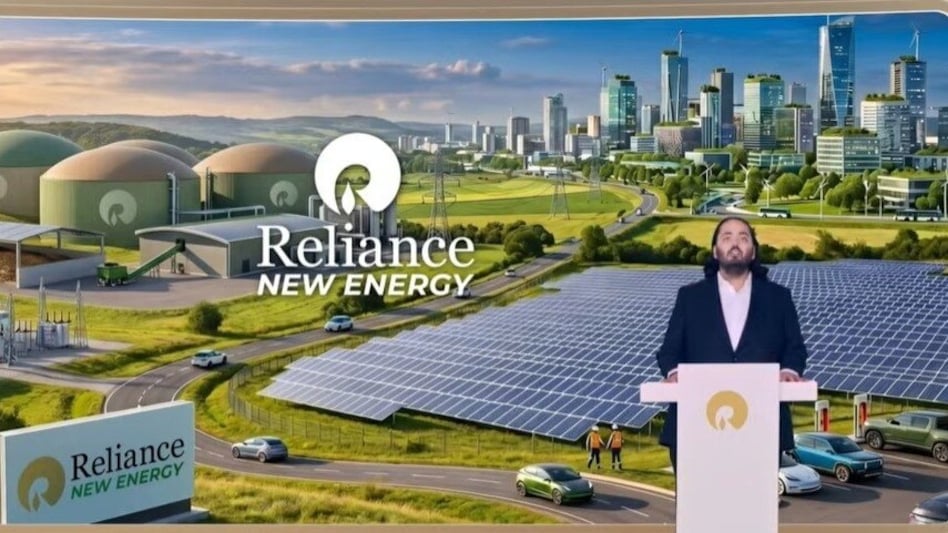
 At Reliance Industries' AGM, Anant Ambani outlined plans to expand battery storage and fully integrated solar manufacturing.
Reliance Industries Director Anant Ambani revealed plans to scale the company’s battery energy storage system (BESS) and cell manufacturing capacity to 120 GWh annually. Once operational, it will be one of the biggest in India.
Speaking at the 49th Annual General Meeting (AGM) on June 19, Ambani said the company is building towards 20 GW per annum of fully integrated manufacturing capacity spanning polysilicon, ingots, wafers, cells, modules and glass.
India has a solar module manufacturing capacity of over 200 GW a year but only the capacity to make 27 GW of cells, the primary component to convert sunshine into electricity. Cells are the building blocks of solar modules. The module manufacturing requires polysilicon, which is melted to form solid blocks of silicon known as ingots. These are sliced into wafers, serving as the foundational material for solar cells.
This is where the Chinese dependence for the core lies. India has multiplied its solar installations tenfold in the past decade, yet it imports nearly all upstream essentials—98% of wafers and 100% of polysilicon. India has only 2GW of ingot and wafer capacity and nothing of polysilicon.
Reliance has announced that it is building towards 20 GW per annum of fully integrated manufacturing capacity spanning polysilicon, ingots, wafers, cells, modules and glass. It is likely to be one of the biggest industry facilities for solar manufacturing in the country.
Vinay Thadani, Director & CEO, GREW Solar, says India’s renewable energy sector still has a significant level of import dependence, particularly in solar cells and the critical upstream segment, especially wafers, ingots, and polysilicon, remain the next major focus area for the industry.
“Reducing import dependence will be critical for ensuring long term energy security, supply chain stability, and cost competitiveness as India moves towards its ambitious clean energy targets. India’s renewable energy ambitions are scaling rapidly, and manufacturing capabilities must grow alongside deployment,” says Thadani.

 From digital payments to defence: Why India's White Rabbit technology rollout is a big deal
  Accenture rolls out new pay hike model, balancing base salary with one-time payouts
  India's solar push hits a manufacturing hurdle. Here's why the cell mandate was delayed
 Pakistan trade crashes. Afghanistan pitches deeper economic ties with India
 Monsoon Session 2026: Delhi Traffic Police issues route advisory, avoid these roads
 U.S.-Iran War’s 3 Phases Explained: From Khamenei’s Killing To Battle For Strait Of Hormuz
 China’s Helium Export Ban Triggers Global Tech Alarm As Hormuz Crisis Chokes Critical Supply
 CEAT Stock Impact: Why The Company Took A ₹50 Crore Forex Loss | CFO Breaks It Down
 Caliber Mining IPO Opens: Should You Subscribe? Price Band, GMP & Key Risks Explained
 Trump Threatens Iran’s “Pickaxe Mountain”: Why This Nuclear-Linked Bunker Is Hard To Hit
 Federal Bank rally may limit fresh upside; Bandhan Bank shares offer better valuation comfort: Expert
  ICICI Bank, SBI, HDFC Bank, PNB, BoB, Kotak Bank: Price targets for top banking stocks
 RIL Q1 results: O2C recovery drives broadly in-line quarter, says Equirus Securities
 IDBI Bank Q1 results: Net profit rises 5% to Rs 2,115 crore; NIM falls 54 bps QoQ
  Adani Ports: Post 30% rally in six months, more upside likely for the Adani Group stock?









