P.K. Gopalan, 60, a resident of Ezhumangad village in
Kerala's Palakkad district, has been making pots and other articles from mud for the last 50 years. He is one of the hundreds of potters whose livelihoods depend on the availability of quality clay. For generations, the riverbed of Bhratha Puzha or the Nila river, as it is also known, gave the potters the mud they wanted. They would extract the mud by digging a few feet into the riverbed.
However, in the last several months, the potters have faced problems as the government has imposed restrictions on mining to save the river. "The destruction has been caused by sand miners, who employ large excavators, and not by tiny potters like us," says Gopalan.
The Nila river originates from the
Western Ghats in Tamil Nadu and flows about 250 km through the districts of Palakkad, Thrissur and Malappuram in Kerala into the Arabian Sea. It has been a great source of inspiration for Malayalam litterateurs such as Vallathol, Kunjan Nambiar, and M.T. Vasudevan Nair.
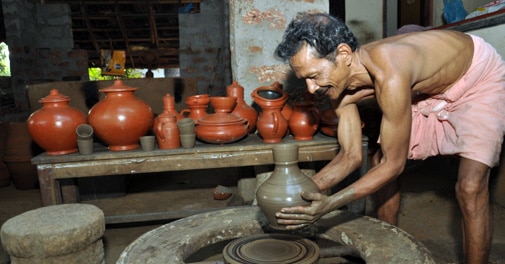
Potter P.K. Gopalan, 60, at work. PHOTO: A.S. Satheesh
But its declining glory has coincided with the gradual rise in the fortunes of Malayalees through Gulf remittances from the 1980s. This prosperity led to rampant construction of palatial houses, exerting pressure on the river Nila for sand.
"The size of houses being built in this region is only proportionate to one's wealth, not one's needs," says 39-year-old Gopinath Parayil, who set up the Nila Foundation in 2004. He has got people from the region to work together to save the river.
Bangalore-based writer Anita Nair is part of the Foundation, and does not lose an opportunity to talk about the river. "As a child, the river was my playpen. In its shallow pools and on its banks, I discovered a world of continuity," she writes in a travelogue posted on her website, www.anitanair.net. Speaking to
BT, she said: "Sand mining requires no investment, so the local youth could get drawn into that. The Foundation is trying to find alternative sources of livelihood for these people."
The Nila Foundation works with riverbank communities engaged in traditional occupations such as pottery, handlooms, fishing, and dairy farming. Because the well-being of the river and of these communities is inter-linked, the team has employed tourism as a tool to convey its message of conservation, says Prakash Manhapra, a member of the Foundation.

A view of the Tirur river, a tributary of the Nila, in Kerala's Malappuram District. PHOTO: A.S. Satheesh
The core activity of the Foundation is to take tourists, both Indian and foreign, to these communities, facilitate interaction and the sale of their products. The tourism season in Kerala starts in September and runs until March. Foundation members get tourists to try their hand at traditional activities such as pottery, coir work and handlooms.
Income from traditional sources will help the communities stick to their professions and save these traditional skills from dying, says Manhapra.








 Nila Foundation activists Gopinath Parayil (left) and Prakash Manhapra on a bank of the Nila river. Photo: A.S. Satheesh
 NSE IPO may unlock mega gains for billionaire investors RK Damani, Premji
 India-US BTA: Harley Davidson bikes to get 0% duty, gradual tariff reduction on luxury cars
 India-US interim trade agreement: 'No GM modified product allowed, agri sector protected,' says Piyush Goyal
 'Decided to give 0% tariff on some cancer medications, neuro treatment': Piyush Goyal on what US got
 ‘How is this a win?’: Chidambaram slams India-US trade framework as opaque, US-tilted
 BT Golf 2025-26 Kochi, Kerala Awards Ceremony Marks A High-Energy, Successful Conclusion
 Golf Is An Addiction. We Eat And Sleep Golf!
 The Fairway Fixes Everything. Mindset, Life, Relationships
 BT Golf LIVE: Join AU Small Finance Bank Presents BT Golf 2025-26 For Its 4th Leg In Kochi, Kerala
 AI Will Change MBAs, Not Leadership: IMD President On India’s Global Education Rise
 RIL, SBI, Kotak Bank, Kalyan, HAL, BEML, BDL among stocks in focus next week; here’s why
 SBI Q3 Results: Profit jumps 24% to Rs 21,028 crore; asset quality improves
 IDBI Bank stake sale: Kotak Mahindra Bank says ‘has not submitted a financial bid’
 BDL, Mazagon Dock, MRF, Hindustan Copper, RVNL, others to turn ex-dividend next week