












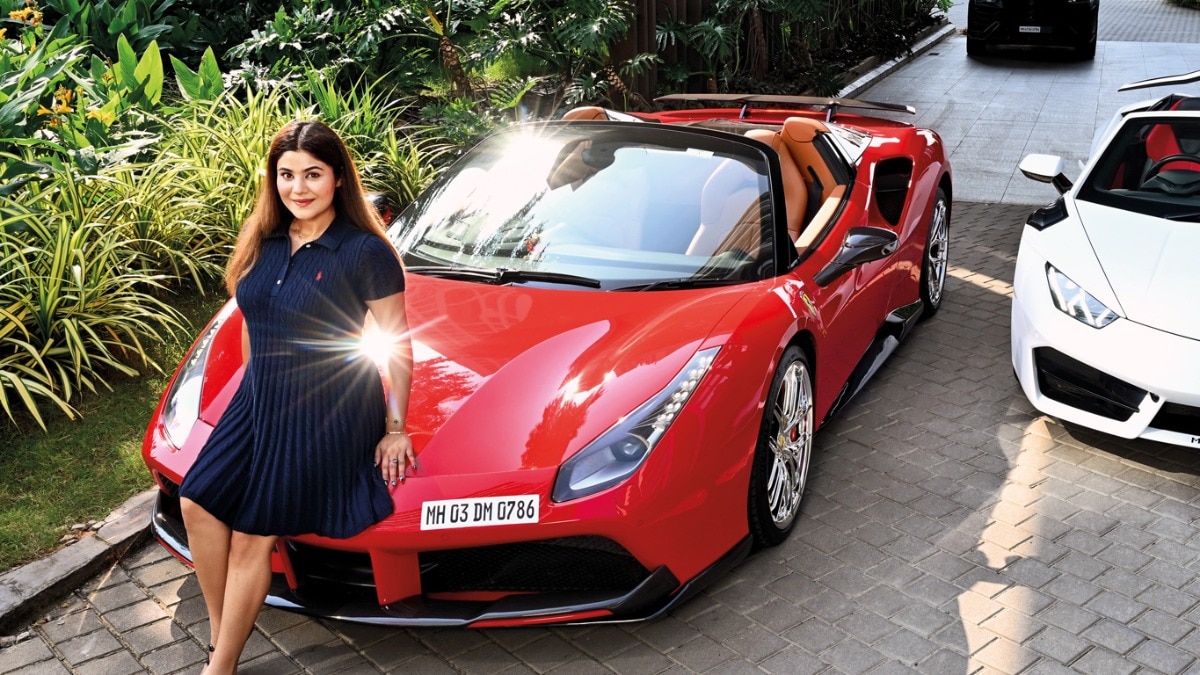
There is something very appealing about the way Shreya Singh talks about fast cars. For the 24-year-old Mumbai entrepreneur who owns gyms, salons, and wellness centres, driving a supercar is not an occasional indulgence. It is how she unwinds, concentrates and, quite often, simply changes her mood.
“I get stressed, I go for a drive. I get angry, I go for a drive,” she says.
Her weekday car is a Lamborghini Urus, chosen for the practical reason that an SUV is easier to drive on Mumbai roads. But her love affair with fast cars culminates over the weekends when she visits the family’s farmhouse in Lonavala. This is where her Ferrari, Porsche, Lamborghini, and McLaren are parked. Among them, the Porsche GT3 RS is special. Singh first fell for the car during a track day at the Buddh International Circuit and eventually got one last year.
Singh talks enthusiastically about the naturally aspirated V10 of her Lamborghini Huracan, the acceleration of the Ferrari SF90 and the dramatic butterfly doors of the McLaren 720S. The latter, she says, makes her feel “like I’m a unicorn and I have wings”.
She owns seven supercars and has an FMSCI, or Federation of Motor Sports Clubs of India, racing licence. For three consecutive years, she has been the fastest woman in the foreign-car category at The Valley Run (an annual drag-racing and motorsport festival, held at the Aamby Valley Airstrip near Lonavala), she says. She has driven through Austria and Germany, taken a Porsche GT3 RS on the Autobahn, and is planning an ice-driving experience in Norway.
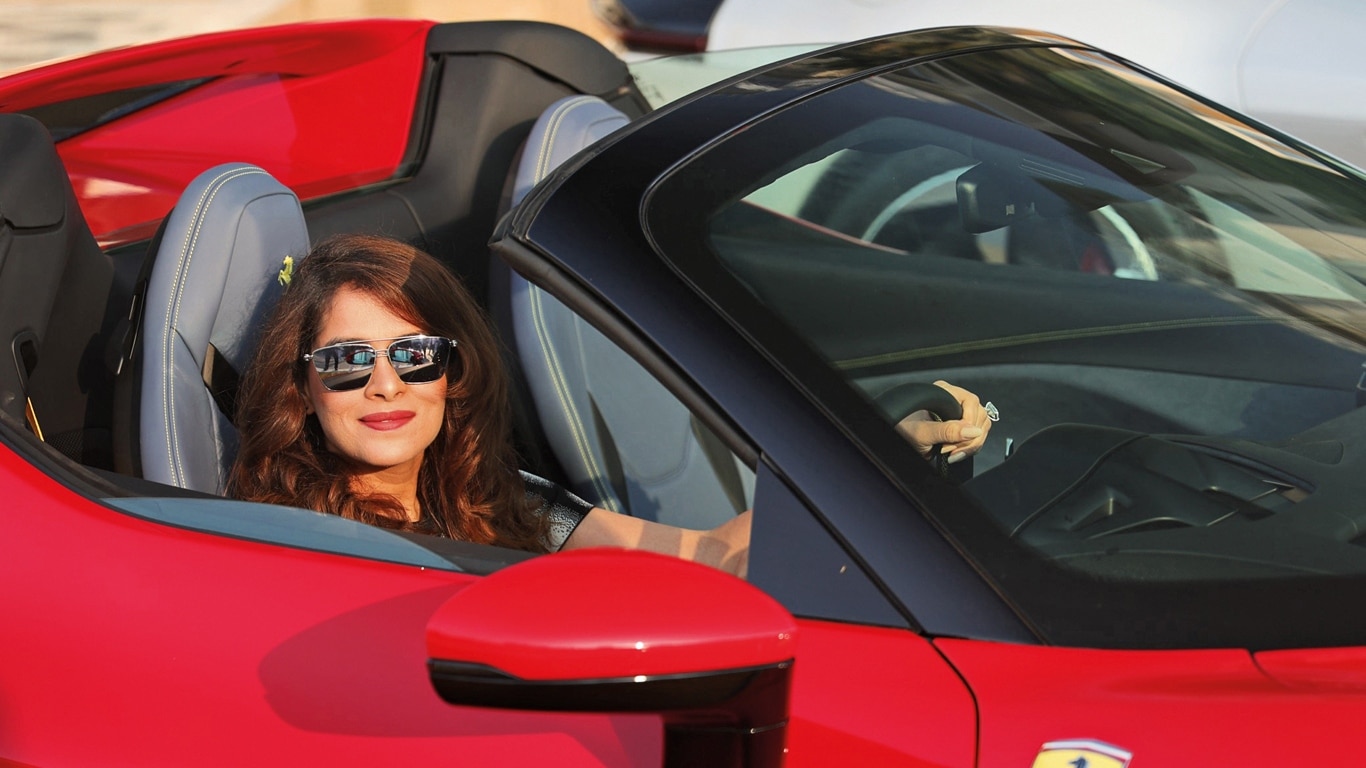
For Sakshi Agarwal, 36, Founder and Chairperson of Path Foundation, (the CSR arm of Prakash Asphalting’s & Toll Highways (India) Ltd), who lives in Mhow near Indore, the supercar is woven into a rather different routine. Her Ferrari 296 GT is frequently used for something unexpectedly domestic: taking her children out for an evening spin.
Agarwal began driving supercars in 2021 with a Lamborghini Urus and added the Ferrari in 2025. She drives between Mhow and Indore several times a week and also takes the Lamborghini to NATRAX, the National Automotive Test Tracks nearby. Inter-city Ferrari and Lamborghini drives provide another outlet.
“I’m not afraid of the speed and the control,” she says. “It just gives me joy and the thrill.”
What she enjoys most is not outright speed, but what she describes as the constant connection with the machine. She is equally comfortable on two wheels, riding a Harley and a Yamaha R15, and enjoys off-roading in a Jeep Rubicon or Range Rover.
Growing up, Agarwal dreamt of owning a red Mini Cooper and a red Ferrari. “Today I own both,” she says with a smile.
That transition, from admiring such cars to independently driving them, is something Ritika Ahuja has watched at close quarters.
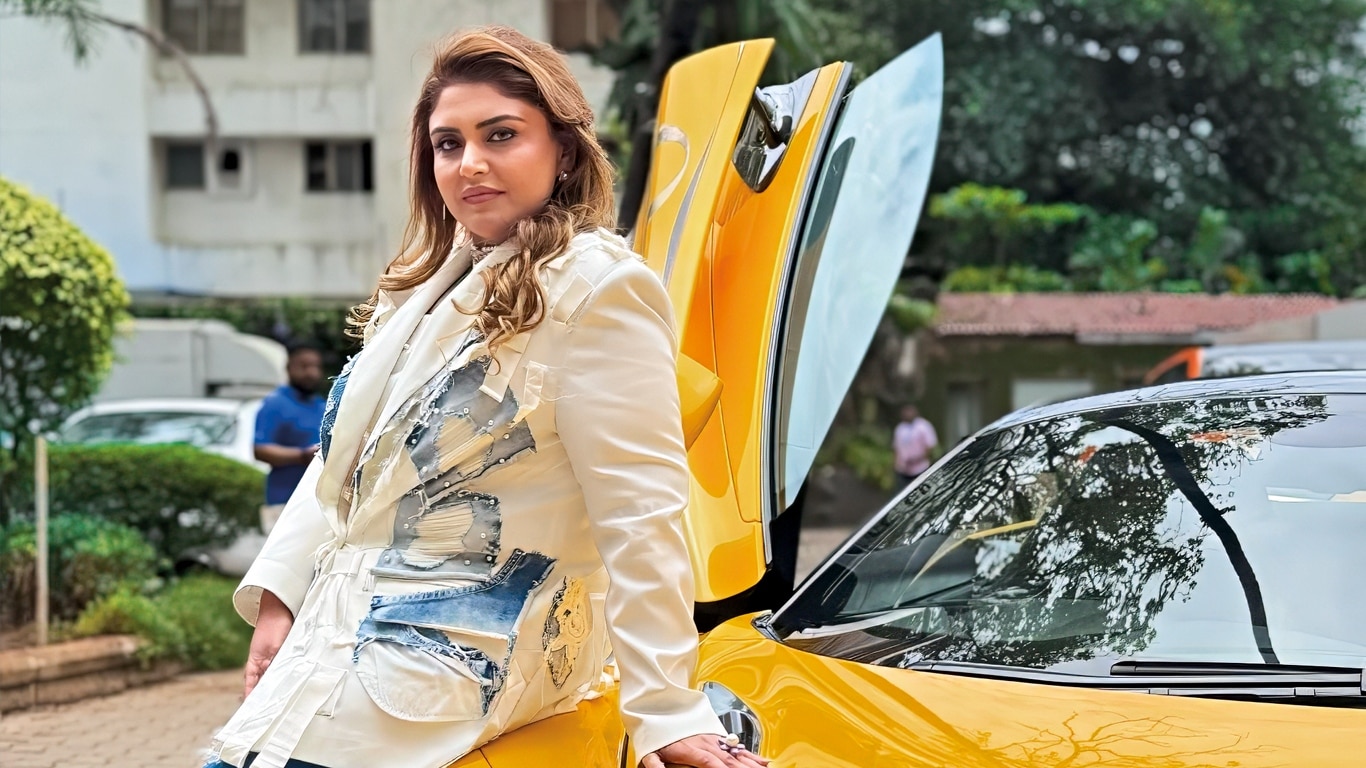
Ahuja, 47, is Chief Operating Officer at luxury pre-owned car retailer Big Boy Toyz and the founder of Queens Drive Club, a community for women who drive high-performance cars. Her fascination began with her father, who also loved automobiles. She drove a Hyundai Accent in college, later graduated to a Mercedes E-Class and, in 2013, moved to her first sports car—a Bentley GT Convertible.
The Bentley had been an aspiration since 2009, when Ahuja was working in Dubai and saw two women driving a pink Bentley convertible with the music turned up. “I think it just became like my aspiration for life,” she recalls.
She currently drives a BMW XM and enjoys the Audi RS Q8 and Ferrari Portofino; but the Bentley remains a favourite. For Queens Drive Club events, she has driven everything from a Ferrari Portofino to a McLaren 720S.
Ahuja says what has changed the most in the supercar culture is who makes the decision. Five or six years ago, men overwhelmingly walked into luxury-car showrooms alone. Today, she estimates that nearly half the customers arrive as couples or families. More importantly, women increasingly make purchase decisions themselves.
The typical woman driving such cars, according to Ahuja, is between 25 and 50, and is often a professional or entrepreneur. Electric performance cars such as the Porsche Taycan and MG Cyberster have been drawing growing interest over the past year, she says.
The buying process is different too. A Rs 2.5-crore or a Rs 3-crore automobile is approached with the seriousness of a property acquisition, Ahuja says. Women customers often want to understand pricing, insurance, taxation, servicing, and resale implications in considerable depth before committing.
That is not lack of interest in cars, she argues, but a consequence of traditionally being excluded from many of the financial and automotive conversations that men grew up hearing. “Women need more handholding,” she says.
Ahuja recalls that when Queens Drive Club began five years ago, some husbands would telephone her, worried that their wives had taken the household supercar out on a club drive. In the past two or three years, she has seen almost the reverse: husbands actively encouraging their wives to buy or drive one so they can participate.
Queens Drive Club now has more than 100 members around India. In Delhi, smaller groups frequently drive together on routes such as Dwarka Expressway and Noida-Agra Expressway, while cars are transported from different cities on flatbeds for the club’s annual drive. What began during Covid simply as a group of women wanting the mood-changing rush of getting behind the wheel has evolved into a national community.
For Singh, that freedom is what being behind the wheel is all about. On weekends, she and her husband leave Lonavala in separate cars. He drives his. She drives hers.
“I don’t want to be the passenger princess anymore,” she says.


