









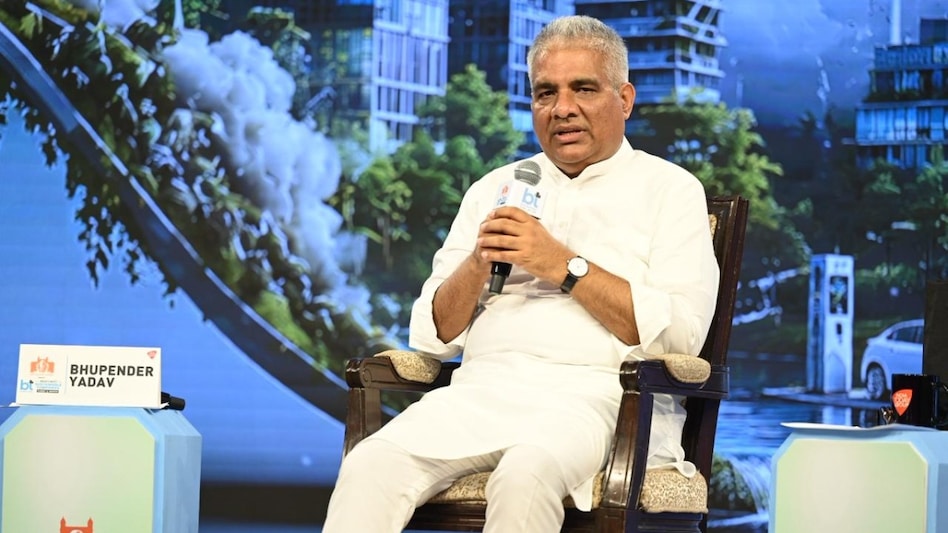
 Addressing environmental concerns, the minister said critics were overlooking the limited land footprint of the project.
 Addressing environmental concerns, the minister said critics were overlooking the limited land footprint of the project.
Union Minister of Environment, Forest and Climate Change Bhupender Yadav on Saturday defended the proposed Great Nicobar development project, saying it had received environmental clearance after following all prescribed procedures and environmental standards, and that the project would involve only 1.78% of the total area of Nicobar.
Speaking at the BT India’s Most Sustainable Companies Summit and Awards, Yadav rejected criticism that the project would come at the cost of ecology, arguing that India’s development and environmental goals can move forward together.
The minister’s remarks came in response to questions on the debate surrounding the Great Nicobar project and criticism from Congress leader Rahul Gandhi.
“Any environmental clearance that we grant is based on established standards and procedures. The environmental clearance for Nicobar was granted after taking all norms into consideration,” Yadav said.
He added that the project had already undergone legal scrutiny. “After that, it was challenged. Today, judicial scrutiny has also taken place,” he said.
Yadav argued that the project is important for enhancing India’s port infrastructure and strategic capabilities.
“India’s security is important for any country. This project will prove to be a major support for strengthening India’s port capacity and maritime security,” he said.
Addressing environmental concerns, the minister said critics were overlooking the limited land footprint of the project.
“The total area involved is 1.78% of Nicobar. Should India not build a major port in a strategically important region, that too while following environmental standards?” he asked.
He also said that conditions attached to the environmental clearance require significant green cover to be maintained.
According to Yadav, a portion of the project area would remain permanently reserved as green space, while compensatory afforestation measures have also been incorporated.
The Great Nicobar project has emerged as one of the government’s most ambitious infrastructure plans. The proposed development includes a transshipment port, airport, power infrastructure and township facilities on the strategically located island near key international shipping routes in the Indian Ocean. The project has faced criticism from environmental groups and activists who have raised concerns about biodiversity, forests and indigenous communities. The government, however, has consistently maintained that all statutory procedures have been followed.
Sustainability and growth can go together
Using the Great Nicobar debate as a broader example, Yadav argued that India’s environmental record demonstrates that economic growth and ecological conservation are not mutually exclusive.
The minister said that before 2014, only around 24-25 eco-sensitive zones had been notified in the country, whereas that number has now increased to 391.
“After coming to power, we notified 391 eco-sensitive zones,” he said.
Yadav also highlighted conservation efforts, noting that the number of tiger reserves has increased from 47 in 2014 to 58 now.
“In any ecology, three kinds of biodiversity protection are required, wetlands, woodlands and grasslands,” he said.
The minister pointed to the expansion of Ramsar sites as another indicator of India’s conservation efforts. “Ramsar sites were 24. Now India has 100 Ramsar sites,” he said.
He further cited data from the Forest Survey of India, saying the country had expanded forest and green cover while continuing to pursue development.
“We increased eco-sensitive zones, protected areas and green areas while carrying out development,” he said.
Renewable energy progress
Yadav also used the platform to highlight India’s clean energy progress.
Referring to a recent report by the International Renewable Energy Agency, he said India had become the world’s second-largest producer of solar energy.
“India’s production from solar energy is now the second highest in the world. We are producing more than the US,” he said.
The minister said India had achieved renewable energy milestones ahead of schedule and had been recognised internationally for its efforts.
According to him, India has increased its renewable energy capacity by 53% and has demonstrated that clean energy expansion can coexist with economic development.
At the same time, Yadav reiterated India’s position that access to energy remains essential for improving living standards.
“When electricity reaches a home, a child gets light to study at night. A woman working in the kitchen gets the comfort of a fan. If you want to improve living standards, you have to provide energy access to every citizen,” he said.
He argued that fossil fuels cannot be eliminated overnight and repeated India’s position in global climate negotiations. “We have said that in the case of fossil fuels there should be a phase-down, not a phase-out,” he said.
Yadav added that India was making progress in solar energy, wind energy, nuclear energy and the National Green Hydrogen Mission as part of its transition towards cleaner sources of energy.
Net-zero and climate action
The minister said India’s 2070 net-zero target has led to policy interventions across sectors including transport, housing, biodiversity conservation, clean energy and technology adoption.
“When we envisioned net zero by 2070, every sector became part of that framework,” he said.
He added that the government is pursuing both mitigation and adaptation measures and is working on a National Cooling Action Plan in response to rising temperatures and heatwaves.
“Government is also working on a National Cooling Action Plan,” he said.
Climate finance and India’s global role
Yadav also reiterated India’s position that developed countries should do more to fulfil climate finance commitments.
“It is true that developed countries occupied the largest share of the world’s carbon space. Their historical responsibility remains,” he said.
While calling for greater support from developed economies, he said India had continued to advance climate initiatives on its own through measures such as green bonds, carbon credit mechanisms, green credit initiatives and international partnerships.
He cited initiatives including the International Solar Alliance, the Coalition for Disaster Resilient Infrastructure, the Leadership Group for Industry Transition and the Global Biofuel Alliance as examples of India’s efforts to drive climate action beyond domestic borders.
Call to Corporate India
Addressing corporate leaders attending the summit, Yadav said companies should invest a portion of their profits in research, innovation, skills and capacity building.
“My suggestion is that we should invest a part of our profits in research, innovation, skills and capacity building. In the future, good technology, good skills and strong capacity will provide the solutions,” he said.
The minister also highlighted India’s efforts to promote a circular economy through regulations covering solid waste management, extended producer responsibility and used-oil management.
Yadav further said that India’s environmental and developmental objectives should not be viewed as competing priorities.
“We are working to maintain both balances,” he said, referring to economic growth and environmental protection.
The Great Nicobar project has become one of the most closely watched tests of that approach. While critics continue to raise concerns over ecological impacts, the government maintains that the project has followed environmental norms, undergone judicial scrutiny and remains important for India’s strategic and economic interests.
FAQs
What did Bhupender Yadav say about the environmental clearance for the Great Nicobar project?
Bhupender Yadav said the Great Nicobar project received environmental clearance only after following all prescribed norms, standards and procedures. He also stated that the clearance had faced legal challenge and undergone judicial scrutiny.
Why does the government consider the Great Nicobar project important?
The government says the project is important for boosting India’s port infrastructure, maritime security and strategic capabilities. It includes a transshipment port, airport, power facilities and township infrastructure near major international shipping routes.
How much of Nicobar’s area will be used for the proposed development?
According to the minister, the project will involve only 1.78% of the total area of Nicobar. He also said environmental conditions require green space to be maintained and compensatory afforestation to be carried out.
How did Yadav link sustainability with economic growth in India?
Yadav argued that development and environmental protection can progress together. He cited the rise in eco-sensitive zones, tiger reserves, Ramsar sites and forest and green cover as examples of India pursuing conservation alongside growth.
What did the minister say about India’s renewable energy and climate action efforts?
Yadav said India is now the world’s second-largest producer of solar energy and has increased renewable energy capacity by 53%. He added that India is advancing solar, wind, nuclear and green hydrogen efforts while working towards its 2070 net-zero target.
 Rajesh Exports shares in free fall mode: Back-to-back lower circuits - What SEBI Chairman said
 Why Adani is onboarding L&T for nuclear power projects?
  IT hiring falls to 28-month low, but demand for AI talent remains strong
 Lilly’s experimental drug now shows benefits across obesity, diabetes, other conditions
  Three Air India aircraft damaged in storm in Delhi; DGCA orders probe
 "We Are Ready To Sell Su-57 To India": Putin Makes Big Fighter Jet Offer
 Russians, Americans & Indians Are Betting Big On UAE Real Estate | Ankur Aggarwal, BNW Developments
 How PM Modi’s Ujjwala Yojana Transformed 10 Crore Families and Empowered Women Across India
 TECH-IT-EASY | The Tech Gear Show EP 5 | Latest Technology News | Business Today
 Latest Launches Of The Week With AI SANA | Tech Gear EP 5 | Business Today
 Vodafone Idea, Bharti Airtel share price targets: This chart shows why tariff hikes from Q2 hold the key
 CMR Green IPO: Step-Step to guide to check your allotment status on BSE, NSE as GMP zoomsRajesh Exports shares in free fall mode: Back-to-back lower circuits - What SEBI Chairman said
 Wipro, MTAR Technologies, Netweb Technologies shares slip up to 8% today
  YES Bank shares rebound to near 52-week high despite GST notice; check target price & more