









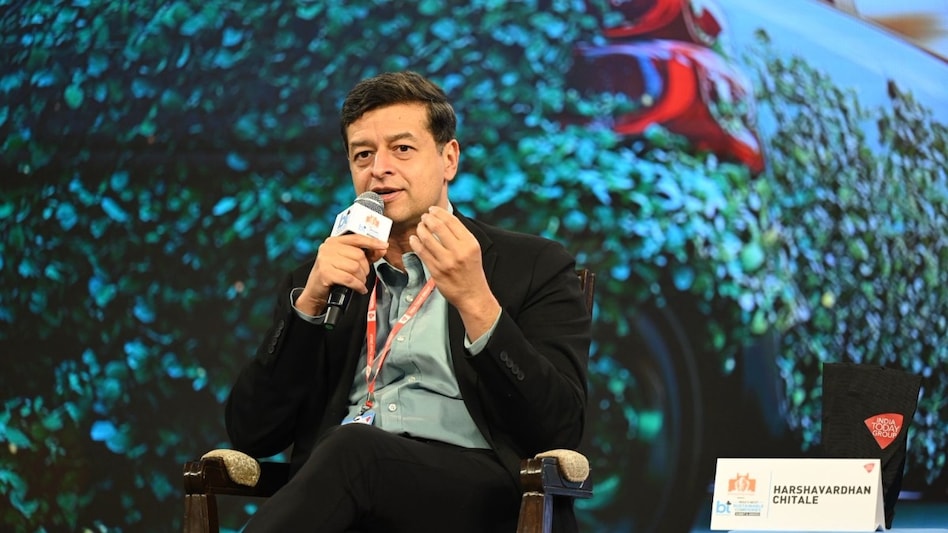
 Addressing consumer concerns around flex-fuel vehicles, Chitale emphasised that the company's newly launched models are designed to offer flexibility.
 Addressing consumer concerns around flex-fuel vehicles, Chitale emphasised that the company's newly launched models are designed to offer flexibility.
Sustainability can no longer be confined to manufacturing operations alone and the next challenge is creating sustainable products that reduce environmental impact throughout their usage cycle, Hero MotoCorp CEO Harshavardhan Chitale said in ‘The Eco Drive’ session at BT India's Most Sustainable Companies Summit and Awards.
India's automotive sector will ultimately need large-scale electrification to meet the country's net-zero commitments, believes Chitale. Yet he cautioned that the transition will take time. That reality, he said, makes biofuels an important solution for the near term.
"Nothing is better than biofuel for immediate carbon reduction," he explained.
Addressing consumer concerns around flex-fuel vehicles, Chitale emphasised that the company's newly launched models are designed to offer flexibility. Flex-fuel vehicles can operate on conventional gasoline as well as higher ethanol blends, he said, adding that engine automatically detects ethanol content and optimises performance accordingly.
On affordability, Chitale said Hero MotoCorp's flex-fuel vehicles currently cost only about 3-4% more than comparable conventional ICE (internal combustion engine) models. He emphasised that the price premium is temporary and is expected to disappear as production volumes increase and the technology scales up.
Drawing parallels with countries such as Brazil, he said multiple fuel choices are likely to coexist. India, he argued, needs multiple pathways rather than a one-size-fits-all solution.
Chitale said Hero MotoCorp had set what many considered an aggressive sustainability agenda: achieving carbon neutrality by 2030, becoming water positive, eliminating waste sent to landfills, and making products increasingly recyclable.
Six years into that journey, he said the company is firmly on track. Carbon emissions have already been reduced by 45% from baseline levels, while Hero MotoCorp has become 500% water positive, replenishing five times more water than it consumes. This achievement is particularly significant because several of its manufacturing facilities operate in water-stressed regions such as Rajasthan. According to Chitale, the impact of these conservation efforts is already visible in nearby communities.
The company has also reached 95% product recyclability, far exceeding the automotive industry's AIS 129 standard that requires 80% recyclability.
FAQs
Why does Hero MotoCorp see sustainable products as the next big challenge?
Hero MotoCorp says sustainability cannot stay limited to manufacturing alone. The focus now is on creating sustainable products that reduce environmental impact across their full usage cycle, from fuel use to recyclability.
Why are biofuels important for India’s automotive sector right now?
According to CEO Harshavardhan Chitale, large-scale electrification is necessary for India to meet its net-zero goals, but it will take time. In the near term, biofuels offer an immediate and practical way to cut carbon emissions.
How do Hero MotoCorp’s flex-fuel vehicles work?
Hero MotoCorp’s flex-fuel vehicles can run on regular petrol as well as higher ethanol blends. The engine automatically detects the ethanol content and adjusts performance, giving riders flexibility without needing major intervention.
Are flex-fuel vehicles much more expensive than conventional ICE models?
At present, Hero MotoCorp’s flex-fuel vehicles cost around 3-4% more than comparable internal combustion engine models. The company expects this gap to reduce and eventually disappear as volumes rise and the technology scales further.
What progress has Hero MotoCorp made on its sustainability targets?
Hero MotoCorp says it is on track towards carbon neutrality by 2030. The company has reduced carbon emissions by 45% from baseline levels, become 500% water positive, and achieved 95% product recyclability, which is well above the AIS 129 standard of 80%.
 Rajesh Exports shares in free fall mode: Back-to-back lower circuits - What SEBI Chairman said
 Why Adani is onboarding L&T for nuclear power projects?
  IT hiring falls to 28-month low, but demand for AI talent remains strong
 Lilly’s experimental drug now shows benefits across obesity, diabetes, other conditions
  Three Air India aircraft damaged in storm in Delhi; DGCA orders probe
 "We Are Ready To Sell Su-57 To India": Putin Makes Big Fighter Jet Offer
 Russians, Americans & Indians Are Betting Big On UAE Real Estate | Ankur Aggarwal, BNW Developments
 How PM Modi’s Ujjwala Yojana Transformed 10 Crore Families and Empowered Women Across India
 TECH-IT-EASY | The Tech Gear Show EP 5 | Latest Technology News | Business Today
 Latest Launches Of The Week With AI SANA | Tech Gear EP 5 | Business Today
 Vodafone Idea, Bharti Airtel share price targets: This chart shows why tariff hikes from Q2 hold the key
 CMR Green IPO: Step-Step to guide to check your allotment status on BSE, NSE as GMP zoomsRajesh Exports shares in free fall mode: Back-to-back lower circuits - What SEBI Chairman said
 Wipro, MTAR Technologies, Netweb Technologies shares slip up to 8% today
  YES Bank shares rebound to near 52-week high despite GST notice; check target price & more