








 The findings are significant because the present-day Bay of Bengal coastline lies about 60 km from Baripada. The fossils indicate that seawater once extended much farther inland.

 The findings are significant because the present-day Bay of Bengal coastline lies about 60 km from Baripada. The fossils indicate that seawater once extended much farther inland.
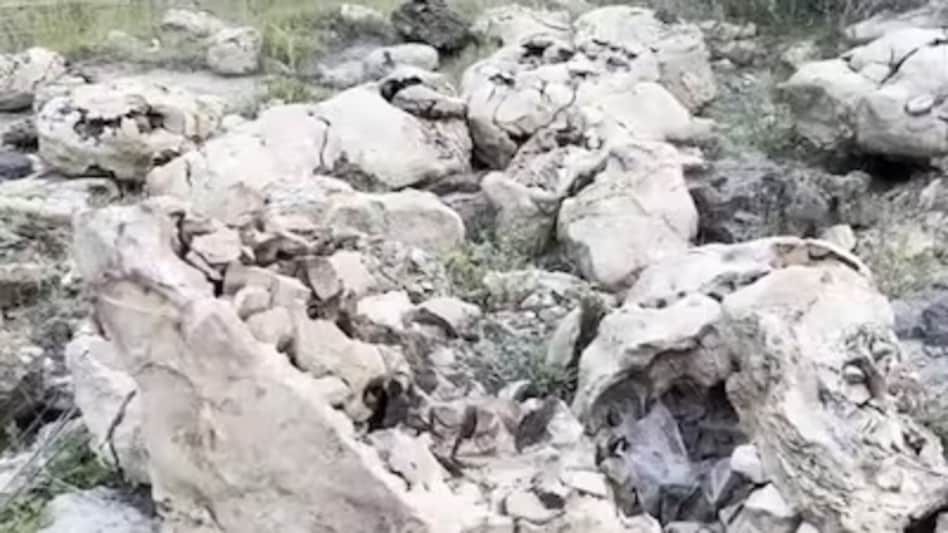
Fossil remains long referred to by villagers in Odisha’s Mayurbhanj district as ‘Asura hadda’, or ‘demon bones’, have been identified as the remains of ancient marine creatures dating back nearly 15 million years. The discovery has opened a window into a prehistoric landscape and added to evidence that large parts of eastern India were once covered by a shallow sea during the Miocene epoch.
The remains include well-preserved shark teeth, vertebrae and other marine fossils found in the Baripada Fossil Beds along the Budhabalanga river. Researchers said the find sheds light on Odisha’s geological past and suggests that an area now inland was once part of a coastal ecosystem.
The discovery was made during an educational field visit led by Dr Debabrata Nandi, Assistant Professor at the PG Department of Remote Sensing and GIS, North Orissa University. While accompanying students near Baripada in Mayurbhanj district, Dr Nandi noticed unusual remnants embedded in the landscape that appeared to be fossils.
When the team spoke to local residents, they found that the objects were locally known as ‘asura hadda’. What began as an inquiry linked to local folklore later developed into a palaeontological discovery.
Subsequent examination showed that the remains belonged to ancient marine species, including sharks that inhabited the region around 15 million years ago. Researchers studying the fossil beds said the material confirmed that the area had once supported a marine environment.
The findings are significant because the present-day Bay of Bengal coastline lies about 60 km from Baripada. The fossils indicate that seawater once extended much farther inland, covering parts of what is now the district’s terrestrial landscape.
Scientists believe the region’s geography changed over millions of years because of shifts in sea level, sediment build-up and tectonic movement. These changes may have gradually pushed the coastline eastward, leaving marine remains buried under layers of earth.
Experts said the fossil assemblage could help researchers study prehistoric ocean ecosystems and the biodiversity that existed in eastern India during the Miocene period. The shark fossils, in particular, may offer clues to evolutionary patterns among ancient shark species and help reconstruct the environmental conditions of that time.
The Baripada fossil zone, spread across several villages in Mayurbhanj, is increasingly being recognised as an important geo-heritage site. Scientists said the area has substantial research potential and could yield further discoveries linked to India’s ancient marine history.
Dr Nandi and his team have begun working with palaeontologists from several research institutions to identify the remaining fossils and reconstruct the ancient ecosystem that once existed there. Alongside scientific study, there are growing calls for formal protection of the fossil-rich zone and for it to be developed as a fossil park or geo-heritage destination for conservation, education and tourism.
For now, the discovery has turned what villagers once saw as mysterious ‘demon bones’ into an important part of Odisha’s prehistoric record, pointing to an ancient sea, long-extinct sharks and a landscape in Mayurbhanj very different from the one seen today.
 NSE IPO vs Reliance Jio IPO: Issue size compared
 NSE IPO: Exchange likely to raise Rs 30,000 crore— Are unlisted shares trading at premium?
 Diesel price surge: Highway developers to get compensation from centre
 'Shows how nations can defeat terror networks': Israeli envoy praises Dhurandhar
 'India AI Summit was extremely disorganised': Dario Amodei on viral stage moment with Sam Altman
 Which Sectors Worked Best For BOI Mutual Fund? Alok Singh Reveals The Top Performers
 Indian Stock Market News: Why Pharma, Hospitals And Diagnostics Remain Long-Term Compounders
 Why Expert Believes AI Could Trigger The Next Growth Wave For Indian IT Stock
 Falling Oil Prices And A Stronger Rupee: Experts See A Big Opportunity For India
 "India Will Write The Last Word On AI": Piyush Goyal's Bold Tech Vision From France
 Nifty rises 1,000 pts in six days, trend reversal or more gains ahead?NSE IPO: Exchange likely to raise Rs 30,000 crore— Are unlisted shares trading at premium?NSE IPO vs Reliance Jio IPO: Issue size compared
 Jaiprakash Associates shares delisted from BSE, NSE; key details
 Up 18% in a month! Falling crude isn't the only tailwind for this multibagger stock