















 Constitutional scholars and press advocacy groups quickly condemned the executive decision, warning that viewpoint-based discrimination violates foundational First Amendment protections.
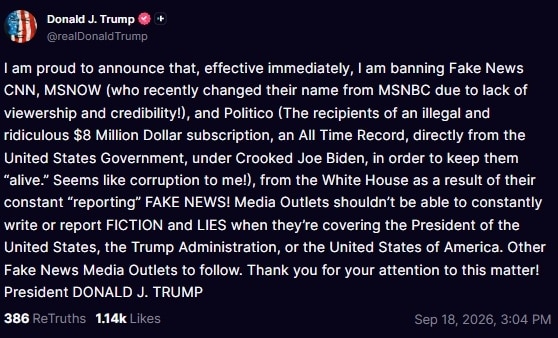
 In an unprecedented standard of media restrictions on White House grounds, President Donald Trump announced the immediate revocation of press access for three major news organizations — CNN, MS NOW, and Politico — accusing the outlets of distributing targeted "fake news".
Trump made the announcement via a Truth Social post, writing: "I am proud to announce that, effective immediately, I am banning Fake News CNN, MSNOW… and Politico… from the White House as a result of their constant 'reporting' FAKE NEWS!" He added a warning that "other Fake News Media Outlets to follow," specifically singling out the New York Times and Washington Post during a subsequent Oval Office appearance.

 'We don't fear competition': Reliance hits back at Musk's Starlink India claims
 BT BIG STORY: 'Ratan Tata never wanted to list Tata Sons'
 Jio Platforms IPO enters crypto markets as Bitget launches pre-IPO futures for valuation bets
 India may raise fuel prices in November, says economist Alexandra Hermann Prasad
 Is Tesla bringing flying cars? Elon Musk's teaser video clip triggers buzz. Watch
 Sennheiser Momentum 5 Review: Best Premium Headphones Under ₹40,000?
 Jio Platforms IPO: ₹30,000 Crore Issue Opens October 21, Valuation At ₹10.3 Lakh Crore
 Weekend OTT Releases: The Diplomat 4, Aasha, Sacrifice And More
 How Jio Transformed India From Data Scarce to Data Abundant! | Akash Ambani | Jio Platforms IPO
 Akash Ambani Decodes Jio's Financial Muscle | Reveals The 5 Key Business Drivers | Jio Platforms IPO
 Tech Mahindra shares surge 8% as Q2 margins beat estimates; check brokerage targets
 Polycab Q2: Brokerages share price targets, firm says negligible impact of UltraTech's entry into sector
  YES Bank's AT1 bonds writeoff: Rs 11,000-crore hit for shareholders, Kotak says lender may need to raise capital
  Cyient DLM shares crash 19% after Q2 miss, guidance; JPMorgan, Antique, MOFSL targetsJio Platforms IPO enters crypto markets as Bitget launches pre-IPO futures for valuation bets
 Centre likely to convene Special Session of Parliament later this month; delimitation, women's reservation bill on agendaTech Mahindra shares surge 8% as Q2 margins beat estimates; check brokerage targetsPolycab Q2: Brokerages share price targets, firm says negligible impact of UltraTech's entry into sector India may raise fuel prices in November, says economist Alexandra Hermann Prasad
 Gold, silver prices on October 16: Check latest rates in Delhi, Mumbai, Kolkata, other cities


